
Showing posts with label gardening. Show all posts
Showing posts with label gardening. Show all posts
Friday, August 07, 2009
Love Your Farmers Market
I just voted in the "Love Your Farmers Market" contest sponsored by Care2.com and LocalHarvest.org to help my favorite market, Ferndale Farmers' Market, win a grand prize of $5,000. I care about promoting fresh, local and healthy foods, and I need your help to get enough votes to help Ferndale Farmers' Market win. Please vote here: http://www.care2.com/farmersmarket/17312?refer=21496.01.1249686504.164956.
Monday, June 08, 2009
Sheesh what a day!
It has been ages since I've posted. I'd like to say it was because I was busy in the garden, but that wouldn't be entirely true. That has been part of it, but only part. For the last week and half I've been sick with some crap that's taken on all kinds of symptoms. I've been stressing about the economy, specifically our own personal economy, trying to keep up at work, with the girls school work and social life, dishes dishes dishes (remember the dishwasher is broken) and a myriad of other things. I have been busy taking pictures along the way, and have tons to post. Now, where to begin.
Tonight, I'm exhausted. It's day 11, going on 12 of whatever this crud is I'm sick with. I got home today and immediately went down for a nap before the girls came home. I got in an hour, barely woke up to my husband scrambling to deal with some kind of chaos in the field. I crawled out and looked out in the field for him to look back in exasperation and say, "OH Shit! They're on the roof!"
That's the goats he's talking about. I yell back, "OK!" Throw on my crocks ( not the best shoes for the challenge ahead) and run up our slope behind the garage and hope I can lure the goats off without actually getting on the roof. (I'm scared to death of heights.) It worked! But then.....
What do I do now? I have to somehow get them back in the field.....alone,
I head for the upper gate next to the chicken coop with Sugar Magnolia following in hot pursuit. This could be good or bad. Is she happy to follow or pissed? Turns out she's pissed. As I try to unhook the makeshift gate with my dog nipping at Sugars feet, she pins me, all 150 lbs of her, against the fence post, and proceeds to push harder and harder until the fence post starts to uproot! I'm yelling for my husband to help, I can't move, she's got me pinned. Then I look up to see him walking slowly towards us, in the neighbors field, holding his chest. Oh shit! He broke his ribs, again. He can't help me. I look behind me and Mocha is looking for an in to give me a good butt. I'm getting angry now. I grab Sugar by the horns and to my surprise I've got her under control. Gotta love adrenaline. Unfortunately I can't hold her with one hand and open the gate with the other. Finally I get it open and realize I can't let her in the way I planned. The 4-H sheep are in there and Sugar can't go there. I check on John and head back the other way. The goats follow, not too closely thankfully. Then they attack my apple tree! Now I'm really pissed!
Between John, our dog CB and me we finally get those damn goats back in the field. But to really top off my day, we walk down to the vegie garden and discover that something ate every single ( about 40) beet sprout I had planted the night before. I drug my sick butt out to the garden and planted the sprouts that my daughter started only to find them demolished. A garden day from hell I'll tell ya!
Tomorrow, I'll have more pleasant stories to tell. I have had some successes and I have tons pictures to share.
Next time you're having a bad gardening day, be glad you don't have any goats on your roof.
Happy gardening!
Tonight, I'm exhausted. It's day 11, going on 12 of whatever this crud is I'm sick with. I got home today and immediately went down for a nap before the girls came home. I got in an hour, barely woke up to my husband scrambling to deal with some kind of chaos in the field. I crawled out and looked out in the field for him to look back in exasperation and say, "OH Shit! They're on the roof!"
That's the goats he's talking about. I yell back, "OK!" Throw on my crocks ( not the best shoes for the challenge ahead) and run up our slope behind the garage and hope I can lure the goats off without actually getting on the roof. (I'm scared to death of heights.) It worked! But then.....
What do I do now? I have to somehow get them back in the field.....alone,
I head for the upper gate next to the chicken coop with Sugar Magnolia following in hot pursuit. This could be good or bad. Is she happy to follow or pissed? Turns out she's pissed. As I try to unhook the makeshift gate with my dog nipping at Sugars feet, she pins me, all 150 lbs of her, against the fence post, and proceeds to push harder and harder until the fence post starts to uproot! I'm yelling for my husband to help, I can't move, she's got me pinned. Then I look up to see him walking slowly towards us, in the neighbors field, holding his chest. Oh shit! He broke his ribs, again. He can't help me. I look behind me and Mocha is looking for an in to give me a good butt. I'm getting angry now. I grab Sugar by the horns and to my surprise I've got her under control. Gotta love adrenaline. Unfortunately I can't hold her with one hand and open the gate with the other. Finally I get it open and realize I can't let her in the way I planned. The 4-H sheep are in there and Sugar can't go there. I check on John and head back the other way. The goats follow, not too closely thankfully. Then they attack my apple tree! Now I'm really pissed!
Between John, our dog CB and me we finally get those damn goats back in the field. But to really top off my day, we walk down to the vegie garden and discover that something ate every single ( about 40) beet sprout I had planted the night before. I drug my sick butt out to the garden and planted the sprouts that my daughter started only to find them demolished. A garden day from hell I'll tell ya!
Tomorrow, I'll have more pleasant stories to tell. I have had some successes and I have tons pictures to share.
Next time you're having a bad gardening day, be glad you don't have any goats on your roof.
Happy gardening!
Sunday, May 03, 2009
How does your garden grow?
I haven't posted much lately. I've been trying to get busy in my garden. So far I've mainly got my herbs planted. Here's my oregano, plus some marjoram.
 More herbs. I love being able to step out my door and grab fresh herbs when I cook! I have basil, dill, Italian parsley, summer and winter savory.
 My romaine lettuce starts are going well. We need to get that cold frame set up so I can move them. This is the second round on my milk jug cloches. This is a great way to start seeds.
 My amaranth is making a come back.
 My oriental spinach, which I started in my milk jugs a few months ago. It's doing fantastic! I happened to notice our local nursery is selling oriental spinach now. I wonder where they got their seeds. Mine came from China Town in Oakland. I've decided that this stuff will grow pretty much anywhere, since I'm having such success with it. We've recently tested our soil and discovered it's low in everything, nitrogen, phosphorous, potash, and everything else, except acidity, which, typical of the pacific northwest, it's high in.

 The Chinese kale I started in my milk jugs is hanging in there. It's not doing as well as the spinach. It's probably needing one of those elements our soil is low in. Hopefully it will keep hanging in there.
 The artichokes are producing! Yeah!
 Well, back to the garden. I stopped at the nursery yesterday and I created more work for myself. Off to go dig in the dirt.........
 More herbs. I love being able to step out my door and grab fresh herbs when I cook! I have basil, dill, Italian parsley, summer and winter savory.
 My romaine lettuce starts are going well. We need to get that cold frame set up so I can move them. This is the second round on my milk jug cloches. This is a great way to start seeds.
 My amaranth is making a come back.
 My oriental spinach, which I started in my milk jugs a few months ago. It's doing fantastic! I happened to notice our local nursery is selling oriental spinach now. I wonder where they got their seeds. Mine came from China Town in Oakland. I've decided that this stuff will grow pretty much anywhere, since I'm having such success with it. We've recently tested our soil and discovered it's low in everything, nitrogen, phosphorous, potash, and everything else, except acidity, which, typical of the pacific northwest, it's high in.
 The Chinese kale I started in my milk jugs is hanging in there. It's not doing as well as the spinach. It's probably needing one of those elements our soil is low in. Hopefully it will keep hanging in there.
 The artichokes are producing! Yeah!
 Well, back to the garden. I stopped at the nursery yesterday and I created more work for myself. Off to go dig in the dirt.........
Sunday, March 29, 2009
My poor neglected garden
I have been wanting to get down in my garden and weed for days now. I've been meaning to plan out what and where I'm growing everything, and go out and buy my bounty, but life just seems to keep getting in my way. Today was my husbands birthday, so we went shopping for a gift yesterday. My plan was to get his gift, get some lunch stop at the nursery on the way home and head straight to the garden, but birthday boy had other plans, and I never got near my garden yesterday. I also didn't get any of my other chores done, so that's what I did today, and consequently, only enough time to walk through and take pictures of the neglect after dumping my kitchen scraps in the compost bin.
Here are some things I discovered on my garden stroll. I've got volunteer potatoes popping up, and the mint my husband planted is taking over the upper plot.

 This is my Chinese Kale that I started in the milk jug cloches. It's barely hanging in.
 But the Oriental Spinach is doing great! It's taken to our cool coastal weather quite well.
 I also discovered that the artichokes are starting to flower. Yeah!
 This is my pride and joy. I planted this chard a full year ago and it just keeps on producing!

Hopefully I'll be busy weeding and planting in the next few days. If only it would quit raining on the weekends!
Here are some things I discovered on my garden stroll. I've got volunteer potatoes popping up, and the mint my husband planted is taking over the upper plot.

 This is my Chinese Kale that I started in the milk jug cloches. It's barely hanging in.
 But the Oriental Spinach is doing great! It's taken to our cool coastal weather quite well.
 I also discovered that the artichokes are starting to flower. Yeah!
 This is my pride and joy. I planted this chard a full year ago and it just keeps on producing!
Hopefully I'll be busy weeding and planting in the next few days. If only it would quit raining on the weekends!
Saturday, March 07, 2009
Evolution of The Victory Garden Part 3
The Great Depression 1929 to 1939:

The stock market crashed, jobs were lost and people were hungry. Once again municipalities turn to gardens to lessen the burden on the American public. Relief gardening programs were put in place to combat hunger, poverty and emotional stress. These gardens were known as welfare gardens, vacant lot gardens, subsistence gardens and depression relief gardens. It was believed that these gardens would improve health and spirit, create feelings of usefulness, productivity, importance and provide opportunities for food and work.
There were three phases to depression era relief gardens. In the beginning the program was hindered by disagreements on the size and placement of the gardens, who would be involved in creating them, uncertainty on the length of the depression and the fact that these gardens would no longer be grown for the sick and disabled, but for healthy people unable to find work. Most support for these gardens came from the citizens themselves in the beginning.
In 1933 these issues were resolved for a couple of reasons. First non government organizations such as The Family Welfare Society and Employee Relief Commission formed garden committees to combat hunger. People with land were encouraged to cultivate and seeds and supplies were provided. Many farmers disliked this program because they felt that by growing more produce in these relief gardens caused overproduction which in turn maintained the depression. Second, President Franklin D. Roosevelt became president and started the "New Deal". Over the next three years the Federal Emergency Relief Administration (FERA) gave over $3 billion of aid to work garden programs. Gardeners received wages for cultivating and distributing to those in need. This program lasted until 1935.
How well did these programs work? In New York City a gardening campaing led by the Welfare Department and the Works Progress Administration (WPA) created over 5000 gardens in vacant lots producing $5 worth of vegetables for every $1 invested which came to $2.8 million of food produced by 1934.


In 1935 government funding ended and the third phase began. The gardens were no longer viewed as opportunities for success and improvement. The attitude of the public began to change to viewing the gardens as a tool for poverty and laziness, and that they were best geared towards the disabled and sick. The connotation went from "relief" gardens to the pitiful impression of them becoming "welfare" gardens.
But by 1939 another war was brewing in Europe and these connotations would be looking to change soon. Next up, World War II Victory Gardens.

The stock market crashed, jobs were lost and people were hungry. Once again municipalities turn to gardens to lessen the burden on the American public. Relief gardening programs were put in place to combat hunger, poverty and emotional stress. These gardens were known as welfare gardens, vacant lot gardens, subsistence gardens and depression relief gardens. It was believed that these gardens would improve health and spirit, create feelings of usefulness, productivity, importance and provide opportunities for food and work.
There were three phases to depression era relief gardens. In the beginning the program was hindered by disagreements on the size and placement of the gardens, who would be involved in creating them, uncertainty on the length of the depression and the fact that these gardens would no longer be grown for the sick and disabled, but for healthy people unable to find work. Most support for these gardens came from the citizens themselves in the beginning.
In 1933 these issues were resolved for a couple of reasons. First non government organizations such as The Family Welfare Society and Employee Relief Commission formed garden committees to combat hunger. People with land were encouraged to cultivate and seeds and supplies were provided. Many farmers disliked this program because they felt that by growing more produce in these relief gardens caused overproduction which in turn maintained the depression. Second, President Franklin D. Roosevelt became president and started the "New Deal". Over the next three years the Federal Emergency Relief Administration (FERA) gave over $3 billion of aid to work garden programs. Gardeners received wages for cultivating and distributing to those in need. This program lasted until 1935.
How well did these programs work? In New York City a gardening campaing led by the Welfare Department and the Works Progress Administration (WPA) created over 5000 gardens in vacant lots producing $5 worth of vegetables for every $1 invested which came to $2.8 million of food produced by 1934.


In 1935 government funding ended and the third phase began. The gardens were no longer viewed as opportunities for success and improvement. The attitude of the public began to change to viewing the gardens as a tool for poverty and laziness, and that they were best geared towards the disabled and sick. The connotation went from "relief" gardens to the pitiful impression of them becoming "welfare" gardens.
But by 1939 another war was brewing in Europe and these connotations would be looking to change soon. Next up, World War II Victory Gardens.
Monday, January 19, 2009
Spring! Already?
I haven't written here in a while, but I've decided to revive my poor neglected Ignorant Gardener blog. I have so much to say and learn about gardening and it ties in so well with my food blog Omnivores Delight.
So this weekend I had the time to get out in my garden and start cleaning up and getting ready for spring and planting. I had so many Woo Hoo! moments. First was the fact that I had already cleaned up the upper patch of my vegie garden, meaning I only had to focus on the bottom section. I still had beets to harvest and discovered the carrot seeds I accidentally spilled took and I now have several carrots to harvest soon. That is, if I can beat the nasty little gophers to them. I gathered seeds from my collards and broccoli to replant this spring and was surprised to find one of the broccoli plants growing a new head. They're becoming perennial on me. The coolest Woo Hoo garden moment was when I was cleaning out around my artichokes and asparagus. The asparagus that I thought was a failure that I told my husband to plow over with the rototiller because it obviously isn't going to grow in our soil, and then there it is popping up randomly throughout the garden asparagus. The asparagus that I learned later needs three years before it produces anything of significance, but will provide you with a spring crop for the next 20 to 30 years.
Since I first planted those asparagus plants I have since learned from one of the farmers at our local farmers market that where I live is ideal for asparagus. And considering how hard we tried to kill those plants, thinking they were already dead, and there they are putting out spears not just in Spring but in Fall as well, and then yesterday I discover this:

So apparently Spring has arrived in mid January! I real spear of asparagus. It's the only one, but I'm so excited, and I will be planting more now that I know the time line. I think I'll go buy some prosciutto to wrap around that one little spear. All I know is, it may be one spear, but I'm not wasting my precious bounty.
Happy garending!
So this weekend I had the time to get out in my garden and start cleaning up and getting ready for spring and planting. I had so many Woo Hoo! moments. First was the fact that I had already cleaned up the upper patch of my vegie garden, meaning I only had to focus on the bottom section. I still had beets to harvest and discovered the carrot seeds I accidentally spilled took and I now have several carrots to harvest soon. That is, if I can beat the nasty little gophers to them. I gathered seeds from my collards and broccoli to replant this spring and was surprised to find one of the broccoli plants growing a new head. They're becoming perennial on me. The coolest Woo Hoo garden moment was when I was cleaning out around my artichokes and asparagus. The asparagus that I thought was a failure that I told my husband to plow over with the rototiller because it obviously isn't going to grow in our soil, and then there it is popping up randomly throughout the garden asparagus. The asparagus that I learned later needs three years before it produces anything of significance, but will provide you with a spring crop for the next 20 to 30 years.
Since I first planted those asparagus plants I have since learned from one of the farmers at our local farmers market that where I live is ideal for asparagus. And considering how hard we tried to kill those plants, thinking they were already dead, and there they are putting out spears not just in Spring but in Fall as well, and then yesterday I discover this:

So apparently Spring has arrived in mid January! I real spear of asparagus. It's the only one, but I'm so excited, and I will be planting more now that I know the time line. I think I'll go buy some prosciutto to wrap around that one little spear. All I know is, it may be one spear, but I'm not wasting my precious bounty.
Happy garending!
Thursday, July 05, 2007
Gardening Again
Well, after taking a break from writing and gardening, I'm back at both now. My garden was a mess and my pages have been blank. A lot of catching up to do. With a lot of help from my husband we now have a happily growing vegetable garden full of lettuce, cauliflower, broccoli, and many other things. Celery, once again this year is doing extremely well, as is the Pak Choy we tried out this year. Our pole beans aren't fairing too well though. I think there may not be enough sun where they're at. I'm giving asparagus a shot this year. I've heard it's difficult to grow, but that's what they said about celery too. I'll have to be patient for the asparagus. I won't see any harvest until next spring. The peas seem to be doing fairly well so far. Our squash and pumpkins are looking extremely happy as well. One of my happy surprises is that my basil is doing very will this year. I try every year and it just suffers along. But, thanks to the "drought" and all the extra sun we're getting this year, it's doing very well.
My next project is to get some more lettuce starts rolling so we can keep lettuce growing year round. Unfortunately tomatoes are out of the question here until I get a green house. I didn't event bother to try this year. So I'll have to buy all of my tomatoes at the Farmers Market. I'm hoping I can get the energy and gumption up to do some more canning this year. I'd like to have canned tomatoes, peaches, apples etc etc.
So, here we go.......garden on!!!!
My next project is to get some more lettuce starts rolling so we can keep lettuce growing year round. Unfortunately tomatoes are out of the question here until I get a green house. I didn't event bother to try this year. So I'll have to buy all of my tomatoes at the Farmers Market. I'm hoping I can get the energy and gumption up to do some more canning this year. I'd like to have canned tomatoes, peaches, apples etc etc.
So, here we go.......garden on!!!!
Sunday, April 22, 2007
Rhododendron Festival
Rhododendron Parade and Festival April 28th ~ 10 AM
Eureka
This popular community event is sponsored by the Greater Eureka Chamber of Commerce and accepts parade entries from throughout the region. The Year's 35th annual parade will start at Seventh and E Sts. and will travel up Seventh St. to H St., turn south on H and proceed West on Henderson Ave., ending at the Eureka Mall. The annual Rhododendron Show will be held at Miles Hall, St. Bernard's Elementary School, 115 Henderson St., on Saturday. Other events are to be arranged. Those interested in participating should contact the Chamber at 707-442-3738.
Eureka
This popular community event is sponsored by the Greater Eureka Chamber of Commerce and accepts parade entries from throughout the region. The Year's 35th annual parade will start at Seventh and E Sts. and will travel up Seventh St. to H St., turn south on H and proceed West on Henderson Ave., ending at the Eureka Mall. The annual Rhododendron Show will be held at Miles Hall, St. Bernard's Elementary School, 115 Henderson St., on Saturday. Other events are to be arranged. Those interested in participating should contact the Chamber at 707-442-3738.

It's Time To Garden!
Fortuna Feed & Garden Center is having their anniversary sale on April 28th! Woo Hoo!!!!
25% off of everything in the nursery! Yes! And they're having a BBQ and a goat calling competition! Can't wait!
25% off of everything in the nursery! Yes! And they're having a BBQ and a goat calling competition! Can't wait!
Tuesday, December 12, 2006
The Christmas Garden Affair

I'm not doing much gardening these days, although I should be planting my garlic bulbs and putting in some lettuce and spinach starts...yeah, whatever! I just don't want to go out in that rain in the short days. Really, all I want to do is sleep, and read right now. Hibernate! So, I'm trying to read all I can in my little bit of spare time. I've discovered an author who is, first and foremost, a gardener, and a mystery lover. I've never read one of her books, but she comes highly recommended by the librarian. So I'm curious to see how this book pans out. For more check out my

Wednesday, November 29, 2006
Ecolandscape
In connection with my article on landscaping with native plants, I thought I'd share this information I received from Susan Leroy for the following conference in Sacramento:


EcoLandscape Working Group (ELWG) is presenting EcoLandscape 2007: Ecological Landscapes for Sustainable Businesses. This conference will be held on Saturday,
February 3, 2007 at the Samuel Pannell Community Center in Sacramento.
Complete information on the conference is online at http://www.ecolandscape.org.
I have also attached the flyer for the conference.
This event will build on the successes of the 2004 and 2005 conferences by
providing cutting-edge information on how to design, install, and maintain
landscaping in an environmentally-sound manner. Topics will address the
issues of water conservation, peak run-off reduction, soil enhancement,
weed management, storm water pollution, and pesticide and fertilizer
reduction. Highly-acclaimed speakers, combined with a mini-trade show of
innovative products and services, will help landscape professionals meet
the challenges of landscaping in the 21st century.
Speakers at the conference will discuss many of the topics covered in the
forthcoming “River-Friendly Landscaping Guidelines”, which is being funded
by the Sacramento County Stormwater Quality Program. The booklet should be
completed and available for free at the conference.
Please take a moment to visit http://www.ecolandscape.org to see our complete
program. If you have any further questions, please feel free to contact
either me at the number below or Dave Roberts, ELWG chair, at 916-492-0393
or email at info@ecolandscape.org.
We look forward to seeing you at the conference!


EcoLandscape Working Group (ELWG) is presenting EcoLandscape 2007: Ecological Landscapes for Sustainable Businesses. This conference will be held on Saturday,
February 3, 2007 at the Samuel Pannell Community Center in Sacramento.
Complete information on the conference is online at http://www.ecolandscape.org.
I have also attached the flyer for the conference.
This event will build on the successes of the 2004 and 2005 conferences by
providing cutting-edge information on how to design, install, and maintain
landscaping in an environmentally-sound manner. Topics will address the
issues of water conservation, peak run-off reduction, soil enhancement,
weed management, storm water pollution, and pesticide and fertilizer
reduction. Highly-acclaimed speakers, combined with a mini-trade show of
innovative products and services, will help landscape professionals meet
the challenges of landscaping in the 21st century.
Speakers at the conference will discuss many of the topics covered in the
forthcoming “River-Friendly Landscaping Guidelines”, which is being funded
by the Sacramento County Stormwater Quality Program. The booklet should be
completed and available for free at the conference.
Please take a moment to visit http://www.ecolandscape.org to see our complete
program. If you have any further questions, please feel free to contact
either me at the number below or Dave Roberts, ELWG chair, at 916-492-0393
or email at info@ecolandscape.org.
We look forward to seeing you at the conference!
Tuesday, November 28, 2006
Growing Vegetables West Of The Cascades
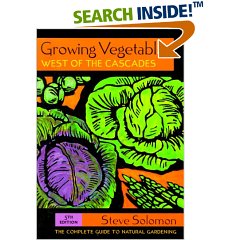
The BEST gardening book I've found for the North Coast!
This is my all time favorite gardening book right now. If I lived south of here or east of here, it wouldn't be very useful, but in Humboldt Co., it's the only book that can explain how to grow vegetables out here. It's actually geared towards Washington and Oregon, but applies quite nicely to Humboldt, especially the northern end of the county. We're a bit warmer than some of the areas described in the book and our growing season is longer. Where this book is very helpful is when it comes to soil. Our soil here is acidic, just as it is north to us, and that plays a huge part in gardening here. We're also very wet here and not too warm, unless you live inland about 40 miles. This book addresses those issues. This book covers an incredible amount in only 340 pages. From soil to composting, to garden planning to water to starting plants from seeds (as well as collecting your own from your plants) to transplanting the seedlings. He even has a section on predators that are indigenous to our area, as well as how to build a cloche. This book is my gardening bible, and if you are a gardener on the north coast, I highly recommend it. Until Amy Stewart quits messing around with flowers and writing for the North Coast Journal and gets down to the business of writing a garden (especially vegies) book for Humboldt County, this will be the only truly useful gardening book for you coastal Humboldt vegie growers.
You can check it out at Humboldt Library and see if it works for you, or go buy it through Amazon.com or see if any of our fine local book stores carry it.
Monday, September 11, 2006
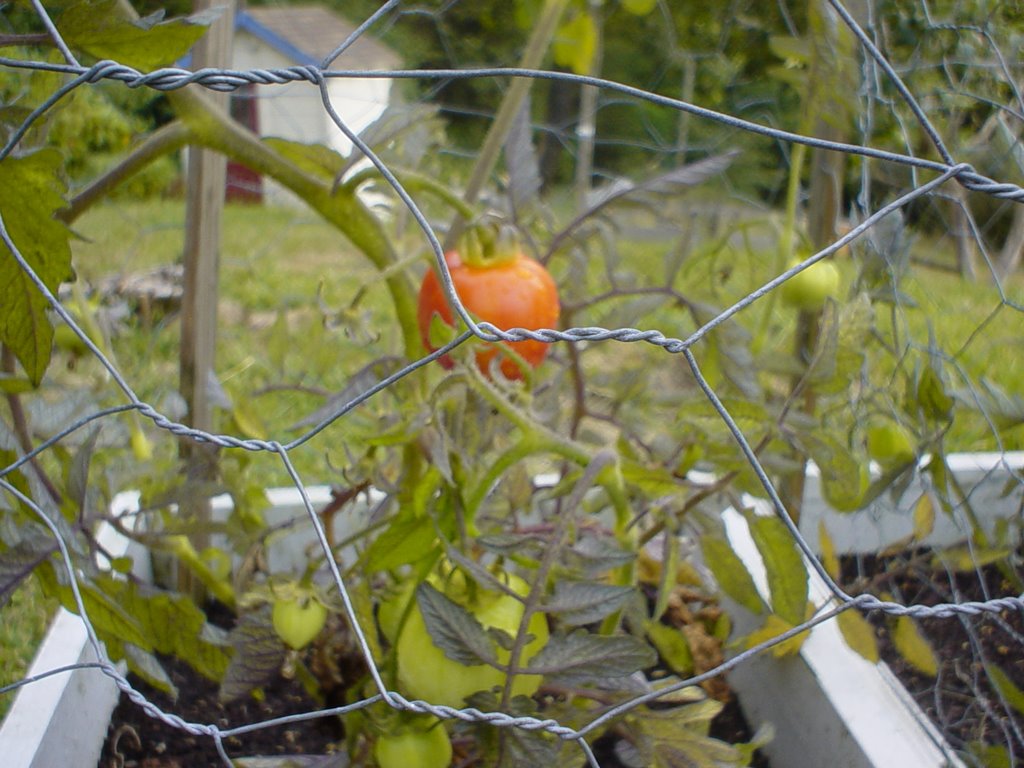
My first ripe tomato. I've had a couple more since this one, which is amazing for living only a few miles from the ocean. It's foggy here most days and it's near impossible to get a tomato to ripen without a greenhouse. So, I figure I'm doing pretty
darn good!
Otherwise, the garden is winding down a bit. My zucchini plant has died off, thank God! I've had enough zucchini to last
me until next summer! Our corn plants are suffering. It's just too shady and damp where we planted them. Next year
we'll try a different spot. Our artichokes are starting to put out some nice artichokes, and our apple tree is brimming full of apples. We're still harvesting broccoli too. I've got lots of beets and carrots coming if the voles will stay out of them. Our
cantaloupe and watermelon plants look nice, but I think it's too late in the year and we won't see any fruit from them. Especially since my dog keeps peeing on them!
I need to start working on clean up, planting some winter crops, like lettuce, spinach and chard, and planting soil amendments. And my poor roses need attention desperately.
Off to the garden!
Monday, August 28, 2006
Gardening with native plants

I've been busy traveling and getting my daughter ready for school, so I haven't had time to post a thing lately. I did have to write an article for my magazine writing class. I chose to write about gardening with native plants. Here's the article:
GARDENING WITH NATIVE PLANTS
Have you driven down the highway in spring and admired the golden hues of the blooms of the scotch broom? Have you admired the beautiful green leaves of ivy growing up the wall of the quaint craftsman down the street? You may even have found these plants at your local nursery and considered planting them in your own yard. But should you?
“Why not?” you may ask. “They’re growing in the wild and sold in the local nursery, so they must be a native plant, and therefore a good thing to plant in my yard.”
It’s true that you may see these plants everywhere along the roadsides and in your nursery, but that does not necessarily make them native. In fact, about three percent of the plant species in California are considered invasive. Three percent may not sound like much, but they inhabit far more area.
A non profit group called the California Invasive Plant Council or Cal - IPC has defined invasive plants as plants that have “evolved in one region of the globe are moved by humans to another region, a few of them flourish, crowding out native vegetation and the wildlife that feeds on it.” These plants affect the soil chemistry, increase the danger of wildfire and flooding and use more water than native plants.
So, what should you take into consideration when considering landscaping with native plants in your garden? Are you concerned about water conservation? Do you have erosion problems? How healthy is your soil? Do you want to limit the use of pesticides and other toxins? Do you want to attract local wildlife, birds, butterflies and other beneficial insects?
These are all things that can be improved, or diminished depending on your plant choices.
To help me in understanding how to make wise plant choices for a healthy native garden I spoke with Susan Taylor. Susan is a local biologist who received her BA degree in biology from Hollins University. She is currently the associate environmental planner for Cal-Trans in Humboldt County. Susan acts as project manager for revegetation projects in which habitat and vegetation are removed for highway projects. She identifies invasive plant species and develops and implements eradication projects for transportation projects. She is also an avid gardener and incorporates native plants in her own garden.
The first thing Susan was adamant about was to never plant an invasive species in your landscape. You will be asking for trouble down the line. They spread so prolifically that they take away from the food supply of the other plants in your garden. They will eventually choke your other plants out. English and German ivy are prime examples of this. When this happens your plant diversity diminishes, which will cause your garden to be more susceptible to pests and disease. A more diverse garden will attract more beneficial insects to your garden, and not compromise the health of the soil. Avoiding invasive plants and planting more native plants will help to maintain a healthy balance in your garden.
Susan also pointed out that “local” is a relative term. Many plants in California can become naturalized to an area that it is not native to. A good example of this is California’s state flower, the California poppy. This flower is “local” to southern California, but it is not native to the northern end of the state. Most people think of this flower as being native to the entire state. Many people also confuse the difference between invasive plants and weeds. Many plants that are considered weeds, like dandelions, are native, and not considered invasive, unless, of course, you are avid about a perfect lawn. Plants that are native to an area, would find it difficult to become invasive in their local habitat because of natural checks and balances within the ecosystem that keep them under control.
Going back to the things to consider when planning your native garden, there are certain advantages, according to Susan, that native plants will have over others. Native plants use less water than non natives or invasive plants. Many native plants aid in erosion control, which is a major issue in northern California. Native plants will reduce the need for pesticides making your garden less toxic, and reducing the cost of gardening. One of the most enjoyable benefits of native plants is that they attract beneficial insects, and many beautiful butterflies, local birds, and other wildlife. The only downside, is that a native plant garden can be slow growing. You won’t have an instant garden, but it is well worth the wait.
In xeriscaping Susan said there are really no native plants she would caution people from using, but if you have a pristine lawn you may want to avoid some plants. Any plant that spreads through rhizomes, like the wood sorrel, or bleeding hearts, can quickly take over a perfect lawn.
So, is it ok to plant non native plants at all? “Yes” says Susan. “Gardening is a personal thing.” she says. “Certain plants hold meaning for people, and gardening can be a very spiritual hobby. If a plant is special to you, by all means plant it”, but, as Susan says, “ be responsible, do your research first.” Make sure it is not considered invasive so that you won’t have problems and have to go through the hassle of removing it later. Keep your garden healthy and diverse.
So, what are some examples of native plants you may want to consider for your garden? Susan suggests local evergreens like redwoods, sitka spruce, or various cedars. The evergreen huckleberry is also a great choice for attracting wildlife. Some deciduous plants to consider are the thimble berry, salmon berry or the California blackberry (avoid the Himalayan blackberry, as it is very invasive.) All provide wonderful edible fruit for humans and wildlife. For erosion control good choices would be bear berry, buck brush (unless you have allergies to it.), and certain grasses, like California oat grass, California fescue, and blue bunchgrass. To add more color and beauty to your garden you may want to consider the seaside daisy, California fuschia, pacific coast iris, or aster (good for stabilizing slopes.).
To learn more about what plants you may want to consider for your natural garden you can contact the North Coast Chapter of the California Native Plant Society at xxx-xxxx, or check their website at www.northcoastcpps.org.This organization provides an excellent list of recommended natives for northwest gardens at northcoastcpps.org/ls.grdn.htm. This list provides the scientific names, common names, and notes explaining the growth tendencies, best uses for, and benefits of growing each plant. For more information on invasive plants check the Encycloweedia website at portal.cal-ipc.org or the Global Invasive Species Initiative at portal.cal-ipc.org.
Native plants that attract hummingbirds (compiled by Jennifer Kalt (3/97) at Northcoast Chapter of CNPS)
crimson columbine
Indian paintbrush
red or orange larkspur
firecracker plant
wild or hummingbird “fuschia”
Humboldt fuschia
scarlet gilia or sky rocket
red flowered rock penstemon
honeysuckle
Sticky monkey flower
cardinal or scarlet monkey flower
Indian warrior
penstemon or beardtongue
coffee berry
cascara sagrada
rhododendron
western azalea
currents and gooseberries
catchfly or campion
hedge nettle
Native Shrubs and small Trees that Attract Wildlife (compiled by Judy Hinmann (9/00) of Northcoast Chapter of CNPS)
red alder
serviceberry
manzanita
dwarf Oregon-grape
Pacific dogwood
California hazel
salal
tan oak
Pacific wax myrtle
Indian- plum
bitter cherry
chokecherry
California coffeeberry
cascara buckthorn
California blackberry
willows
blue elderberry
red elderberry
snowberry
evergreen huckleberry
red huckleberry
Thursday, August 17, 2006
Mourning my pumpkins
I'm still so disappointed about my pumpkins. My husband pointed out that the last vine had been attacked. I almost wanted to cry. Damn it! If I could just figure out what did it. I have to keep them out of my cantaloupe patch.
Otherwise another beautiful sunny day. My tomatoes are making a valiant effort at ripening. Yeah! Maybe I won't have to live on fried green tomatoes! Next year I hope I get a green house. Then I can have ripe tomatoes.
Not much else going on except that my beet seeds are coming up. Yeah! I'm hoping for my carrot seeds to be popping up soon. Unfortunately I won't be here this weekend when they should be popping up. I have to leave my garden in the hands of another! EGADS!
Otherwise another beautiful sunny day. My tomatoes are making a valiant effort at ripening. Yeah! Maybe I won't have to live on fried green tomatoes! Next year I hope I get a green house. Then I can have ripe tomatoes.
Not much else going on except that my beet seeds are coming up. Yeah! I'm hoping for my carrot seeds to be popping up soon. Unfortunately I won't be here this weekend when they should be popping up. I have to leave my garden in the hands of another! EGADS!
Subscribe to:
Posts (Atom)