Wednesday, March 04, 2009

Evolution of The Victory Garden Part 2

The original "Victory Gardens" began during World War 1, even before the U.S. entered the war. In 1914 in Europe, the allies had most of their farmers go off to war leaving crops unharvested and rotting in the fields, most of the farm land had become part of the war zone, and it was becoming more and more dangerous to ship food to Europe due to the German submarines. There was virtually no meat available, and dairy products were so limited that a person had to get a doctors note saying that it was necessary to their health to acquire them. Bread was often not available at all.

In the U.S. citizens had to cut their consumption of food as prices rose and as the burden fell on North America to provide food for 120,000,000 people. Meatless and wheatless days were promoted in order to conserve. As a response to this community gardens started to pop up everywhere.

In 1917 Charles Lathrop Pack founded the National War Garden Commission. The Commission campaigned for backyard Victory Gardens with posters, cartoons, press releases, and pamphlets to "to arouse the patriots of America to the importance of putting all idle land to work, to teach them how to do it, and to educate them to conserve by canning and drying all food that they could not use while fresh." (Pack 1919). Posters had sayings such as, "Will you have a part in Victory?", "Put the slacker land to work", and "Can the Kaiser". President Woodrow Wilson stated that, "Everyone who creates or cultivates a garden helps..."

The U.S. Department of Agriculture formed a committee on public information to help plant "a million new backyard and vacant lot gardens." These gardens were meant to feed America so that the country would be able to send food abroad to support our European allies, and to save fuel and free up transportation and middleman jobs to help with the war effort.

How well did this effort work? In Dallas Texas in 1918 there were 20,000 gardens producing 17,500 cans of vegetables in only a few weeks. In Marion Indiana where 29,000 people resided there were 14,081 gardens. Nationwide in 1917 there were 3 million garden plots. By 1918 that had increased to 5,285,000 plots with a harvest of 528.5 million pounds of produce for that year.

When put to the test, individual Americans can really produce.

Next stop down garden history lane will be Depression Relief Gardens. Stay tuned.

Sunday, March 01, 2009

Evolution of The Victory Garden

I've been hearing the term "Victory Garden" thrown about more and more these days. I had to wonder, how many people really know what a Victory Garden is. Or, should I say was? I grew up hearing the term, having parents who grew up during the depression and who lived through WWII. Their families had Victory Gardens, and they often spoke to me about those gardens, which went beyond vegetables to include chickens, and usually a milk cow. I've seen my Mother shudder at the sight of a butter churner in antique stores. Yes, she had to churn her own butter, but that's another story all together.

My curiosity got the better of me and I decided to blow off chores and do some research on Victory Gardens. I discovered a rich history in American gardening and I'll share what I discovered in my own little series here. So story number one, where did Victory Gardens begin?

I had a vague recollection that WWII Victory Gardens had their start in WWI. When I started researching WWI Victory Gardens I discovered that The U.S. has had a long history of encouraging backyard gardens as a way to get by and even to control the impoverished.

Between 1890 and 1910 a group of middle and upper middle class city dwellers started the City Beautiful Movement. It started out of their fear of the masses of poverty stricken citizens they reluctantly co-existed with. Between 1860 and 1910 the US population had tripled which put a lot of strain on urban areas. Nearly 19,000 people lived in 303 alleys in Washington DC. Sanitation, crime and overpopulation were becoming major issues. It was believed that by beautifying the city it would inspire civic loyalty and improve morals in the poorer civilians, which would, in turn, reduce crime.


Part of this movement involved city gardens, which they hoped would improve the health of the poor population by getting them outside and providing them food and giving them a rest from the stresses of life. One group in Minneapolis grew so much in their City Beautiful garden that they began supplying local stores with their produce.


During the depression of 1893 to 1897 backyard gardens were also encouraged due to increasing poverty and unemployment. Detroit Michigan was hit particularly hard at this time and Mayor Haze S Pingree put out a request to owners of vacant lots to be used by the unemployed to grow vegetables for subsistence. These vacant lot plots later became known as Pingree's Potato Patches. It was hoped, that in doing this, that the food supply would increase and supplement income, and that a sense of self respect and independence would grow as well as gaining the benefits of fresh air and exercise. The gardens ended up saving the city money. Detroit invested $3000 in supplies and in the first year yielded $12,000 worth of vegetables. This allowed the city to not have to raise taxes to support the unemployed and saved Detroit $9000.

2000 people participated over several years between Detroit and Buffalo. One goal for the potato patches was the hope that recent immigrants, like the Polish women pictured above, would socialize and become more ingrained in the "American Way". Similar programs existed in Minneapolis and Denver.

The U.S. has always had a rich agrarian history, but I've never really looked into the city side of that history before. I find it fascinating how city gardening has been used in the past to help the poor become more nourished, not just physically, but emotionally in the past. I have to wonder why (I think I know why) it's not being encouraged so much today.

Next I'll share what I've learned about the Liberty Gardens of the Great War, or better known as World War I.

Saturday, February 21, 2009

More Winter Gardening

I have officially moved my Chinese Kale and Oriental Spinach sprouts to the big garden. Cross your fingers that they survive to food status.

Here is the Kale:
And the Oriental Spinach:
I have to give a big thanks to my girls for helping me plant my starts. Cross your fingers that I'll be posting a yummy recipe for Chinese Kale and Oriental Spinach in a few months.
Happy Gardening!
OH Wait!
On my way to the garden I couldn't resist taking a few pictures of our plum tree. Here is is for your enjoyment:
Spring is so close.....hovering like hope.

Wednesday, February 18, 2009

National Animal Identification System

Being the owner of a small herd of goats, one sheep, soon to be two and a small flock of chickens, I'm just not too sure I like this whole National Animal ID System thing our government is planning on laying on us. Talk about Big Brother!
I learned of this on the Happy Homesteader Blog on the online Mother Earth News. You can read the article here. If you agree with me that this isn't the way to go, be sure to speak out against NAIS. This is all about protecting large agri business and smothering out the small time farmers and ranchers. Let's not let this happen.

Monday, February 16, 2009

Seed Catalogs


So, is anyone else being inundated with seed catalogs? I use to get one or two a year. Then I ordered seed potatoes from Territorial Seed Company last year, and this year, I received 10 catalogs within a 2 month period. Usually I would be irritated by receiving so many catalogs, but seed catalogs today are like the Sears Toy catalog was for me at Christmas time when I was 5 years old. I can spend hours looking at them and dreaming. So, how does one go about controlling themselves and only ordering what they really can grow, and how much do I really need to order. How much can I buy locally?

My plan is, to circle everything I want, then note what I know I can get locally, either from our local nurseries or from our farmers' markets. I've already discovered I can get asparagus crowns, seed potatoes, onions, and rhubarb locally. Even though I can buy purslane and veronica at the farmers market, I can't seem to find the seed or starts for them locally, so those I'll order, along with the other things I can't find locally. But from which catalog?

I've received catalogs from Connecticut to Wisconsin (even though they're called Vermont seed Co.), to Maine to Pennsylvania to Oregon. So, I've decided I'd focus on the one's from Cottage Grove Oregon, specifically Territorial Seed and Abundant Life. They're as local as I can get when it comes to seed catalogs. If there is anything else I can afford to order and really want that I can't get locally or from Cottage Grove, I'll break down and order from the others.

The one other thing I'll have to order from out of state is Sweet Potatoe's. No one will sell to California because they're too restrictive on what can be shipped to the state. It frustrates me that sweet pototoes are grown in California on corporate monster agribusiness farms, but none of these companies will sell slips to small farmers to grow on their own, and no one is allowed to ship slips into California. Well Ha! I've found one place willing and able to ship to California, and I plan to grow sweet potatoes this year. I'd say who this source is, but I'm afraid if I print it here, they'll be stopped from shipping, and I dont' want to do that. Just spend some time googleling and you'll find them.

So now I need to figure out who much I can squeeze into my already tilled garden and how much more of my yard I have time to till or build raised beds onto, then I can start shopping away for all the delightful treats and yummies I hope I can grow this year.

So back to circling all the "toys" I want from those seed catalogs and to all the mapping out and planning!
May we all have and abundant year!

Sunday, February 15, 2009

Winter Gardening

About a month ago I was reading an on line article from Mother Earth News, Use Cold Frames To Grow More Food, and on page 3 a section called Milk Jug Seed Starters got my attention. For one, it was an unusually sunny and warm January here on the North Coast of California, which got me motivated to get out in the garden, and second I have a ton of milk jugs waiting to be taken to the recycling center. I figured why not use a few of them to take care of my itch to get outside and garden.

Back when we took our trip to Oakland's China Town we had picked up several packets of seeds from the markets. Oriental Spinach, Chinese Kale, and Edible Amaranth. They are all suppose to be winter hardy plants, so I decided to experiment and try these seeds out along with some Romaine lettuce seeds in the milk jug seed starters and see if I could achieve some success.


So far I have been pleasantly surprised by the Chinese Kale and the Oriental Spinach. Nothing has sprouted from the Amaranth yet. Being the ignorant gardener I am, I'm not sure what I did wrong. My Romaine sprouted and was doing beautifully, but has since been demolished by some critter, most likely slugs and/or snails. I have one start left from the 20 or so that first popped up. I'll have to give that one another shot and find a safer location. Apparently the slugs and snails don't care too much for the kale or spinach. I hope I didn't just jinx myself by typing that.

Here is my one lonely lettuce sprout, that probably won't make it through the day:

And here are my successes. The Chinese Kale:

And the Oriental Spinach:

And true to the poorly translated from Chinese to English instructions, they are cold tolerant plants and have survived the cold front that has brought freezing temperatures
to our area, beautifully. I should be able to transplant them to the garden without hardening them off, since they've already been acclimated to the weather. At least that's what I'm hoping.

Hopefully I'll be writing of further successes with the Chinese Kale and Oriental Spinach, and that I finally figured out how to get the amaranth to sprout. Oh yeah, and whether I've succeeded in saving any new lettuce sprouts from the slugs and snails. Those evil little slime makers!


Well, off to look up some recipes for Chinese Kale and Oriental Spinach, and some psychological tricks to get my kids to eat them.
Happy Gardening!

Tuesday, February 10, 2009

Humboldt Crud

Well, so much for the big start on my garden blog huh? Soon after I got it rolling again I had a sick kid home, then I got sick, now I have another sick child at home and I just haven't had time to post a thing. I have sprouts started that I'm itching to show you! So hopefully I'll get to that in a day or two. So off to finish up my chicken, garlic, ginger dinner that is suppose to cure us of all evil and illness, (using sage and rosemary from my garden - woo hoo!)
Keep yourselves healthy out there,
Kim

Monday, January 19, 2009

Spring! Already?

I haven't written here in a while, but I've decided to revive my poor neglected Ignorant Gardener blog. I have so much to say and learn about gardening and it ties in so well with my food blog Omnivores Delight.

So this weekend I had the time to get out in my garden and start cleaning up and getting ready for spring and planting. I had so many Woo Hoo! moments. First was the fact that I had already cleaned up the upper patch of my vegie garden, meaning I only had to focus on the bottom section. I still had beets to harvest and discovered the carrot seeds I accidentally spilled took and I now have several carrots to harvest soon. That is, if I can beat the nasty little gophers to them. I gathered seeds from my collards and broccoli to replant this spring and was surprised to find one of the broccoli plants growing a new head. They're becoming perennial on me. The coolest Woo Hoo garden moment was when I was cleaning out around my artichokes and asparagus. The asparagus that I thought was a failure that I told my husband to plow over with the rototiller because it obviously isn't going to grow in our soil, and then there it is popping up randomly throughout the garden asparagus. The asparagus that I learned later needs three years before it produces anything of significance, but will provide you with a spring crop for the next 20 to 30 years.

Since I first planted those asparagus plants I have since learned from one of the farmers at our local farmers market that where I live is ideal for asparagus. And considering how hard we tried to kill those plants, thinking they were already dead, and there they are putting out spears not just in Spring but in Fall as well, and then yesterday I discover this:


So apparently Spring has arrived in mid January! I real spear of asparagus. It's the only one, but I'm so excited, and I will be planting more now that I know the time line. I think I'll go buy some prosciutto to wrap around that one little spear. All I know is, it may be one spear, but I'm not wasting my precious bounty.

Happy garending!

Saturday, September 29, 2007

Article about the Klamath Basin


I found this article interesting mainly because it's where my Dad grew up, it's where my family settled over 100 years ago. Water has been a big issue there since the beginning, and my family, being farmers, have been in the middle of the controversy all along. My grandfather, Charles Brown, worked on the reclamation project. He remembered when Tule Lake use to actually be around the peninsula, and he remembered when a lava tube broke open and a great deal of the lake drained out into the lava tube. Most people blame the farmers for the loss of water, but that's not the case. The Anderson's mentioned in this article are cousins of mine.


My grandmother, the one married to Charles, was an Anderson. She came to Merril Oregon (not far from Malin) in a covered wagon in the early 1900's. It was her family, and the Browns along with others who built the communities and the farms there. Kandra is another name I've grown up hearing. I'm quite sure my dad went to school with a Kandra.

It's interesting to see the North Coast Journal side with the people who farm the refuge, the people who are bringing in the corporate farms. Here in Humboldt it's all about keeping it local and supporting the local small farmers. I guess if it's not in your backyard, then corporate farms are all good. Unfortunately, it's not good for the way of life my family has been trying to live in the Klamath Basin for more than a century.

Friday, July 06, 2007

Deer in the garden, fox in the hen house

Shit! First we have deer jumping in our vegie garden eating our cauliflower, then I wake up to my husband yelling, "We only have one hen left!" Damn! I meant to close up the hen house last night right after dinner. My husband woke up to two "shadows" in the hen yard, turns out they were fox. One ripped the head off of a hen and dug straight into her abdomen to dig the egg out of her body. And people wonder why farmers want to kill off predators. I guarantee if most of these citified wanna be enviro's saw what we saw this morning, they'd be praying to their porcelain gods and plotting their revenge.

Thursday, July 05, 2007

Gardening Again

Well, after taking a break from writing and gardening, I'm back at both now. My garden was a mess and my pages have been blank. A lot of catching up to do. With a lot of help from my husband we now have a happily growing vegetable garden full of lettuce, cauliflower, broccoli, and many other things. Celery, once again this year is doing extremely well, as is the Pak Choy we tried out this year. Our pole beans aren't fairing too well though. I think there may not be enough sun where they're at. I'm giving asparagus a shot this year. I've heard it's difficult to grow, but that's what they said about celery too. I'll have to be patient for the asparagus. I won't see any harvest until next spring. The peas seem to be doing fairly well so far. Our squash and pumpkins are looking extremely happy as well. One of my happy surprises is that my basil is doing very will this year. I try every year and it just suffers along. But, thanks to the "drought" and all the extra sun we're getting this year, it's doing very well.

My next project is to get some more lettuce starts rolling so we can keep lettuce growing year round. Unfortunately tomatoes are out of the question here until I get a green house. I didn't event bother to try this year. So I'll have to buy all of my tomatoes at the Farmers Market. I'm hoping I can get the energy and gumption up to do some more canning this year. I'd like to have canned tomatoes, peaches, apples etc etc.

So, here we go.......garden on!!!!

Sunday, April 22, 2007

Rhododendron Festival

Rhododendron Parade and Festival April 28th ~ 10 AM
Eureka
This popular community event is sponsored by the Greater
Eureka Chamber of Commerce and accepts parade entries from throughout the region. The Year's 35th annual parade will start at Seventh and E Sts. and will travel up Seventh St. to H St., turn south on H and proceed West on Henderson Ave., ending at the Eureka Mall. The annual Rhododendron Show will be held at Miles Hall, St. Bernard's Elementary School, 115 Henderson St., on Saturday. Other events are to be arranged. Those interested in participating should contact the Chamber at 707-442-3738.

Rhododendron Society

Rhododendron Society. 7:30 p.m. Christ Church-Episcopal, Parish Room, 15th and H sts., Eureka. Don Wallace of Singing Trees Gardens presents "The King of Shrubs" slide show illustrating the use of rhododendrons in landscaping. Carol Dunning leads the Rhodo 101 session "Using Rhodies in Flower Arrangements." Refreshments. 443-1291.

It's Time To Garden!

Fortuna Feed & Garden Center is having their anniversary sale on April 28th! Woo Hoo!!!!
25% off of everything in the nursery! Yes! And they're having a BBQ and a goat calling competition! Can't wait!

17th Annual CR Plant Sale

The College of the Redwoods Agriculture program will be holding its 17th annual plant sale on Friday, April 27, from noon until 6 p.m. and Saturday, April 28 from 10 a.m. until 6 p.m. at the CR greenhouse on the main Eureka campus

Tuesday, December 12, 2006

The Christmas Garden Affair


I'm not doing much gardening these days, although I should be planting my garlic bulbs and putting in some lettuce and spinach starts...yeah, whatever! I just don't want to go out in that rain in the short days. Really, all I want to do is sleep, and read right now. Hibernate! So, I'm trying to read all I can in my little bit of spare time. I've discovered an author who is, first and foremost, a gardener, and a mystery lover. I've never read one of her books, but she comes highly recommended by the librarian. So I'm curious to see how this book pans out. For more check out my href="http://lonleystarbookclub.blogspot.com/">Lonely Star Book Club blog


Digg!

Wednesday, November 29, 2006

Ecolandscape

In connection with my article on landscaping with native plants, I thought I'd share this information I received from Susan Leroy for the following conference in Sacramento:


EcoLandscape Working Group (ELWG) is presenting EcoLandscape 2007: Ecological Landscapes for Sustainable Businesses. This conference will be held on Saturday,
February 3, 2007 at the Samuel Pannell Community Center in Sacramento.
Complete information on the conference is online at http://www.ecolandscape.org.
I have also attached the flyer for the conference.

This event will build on the successes of the 2004 and 2005 conferences by
providing cutting-edge information on how to design, install, and maintain
landscaping in an environmentally-sound manner. Topics will address the
issues of water conservation, peak run-off reduction, soil enhancement,
weed management, storm water pollution, and pesticide and fertilizer
reduction. Highly-acclaimed speakers, combined with a mini-trade show of
innovative products and services, will help landscape professionals meet
the challenges of landscaping in the 21st century.

Speakers at the conference will discuss many of the topics covered in the
forthcoming “River-Friendly Landscaping Guidelines”, which is being funded
by the Sacramento County Stormwater Quality Program. The booklet should be
completed and available for free at the conference.

Please take a moment to visit http://www.ecolandscape.org to see our complete
program. If you have any further questions, please feel free to contact
either me at the number below or Dave Roberts, ELWG chair, at 916-492-0393
or email at info@ecolandscape.org.

We look forward to seeing you at the conference!


Digg!

Tuesday, November 28, 2006

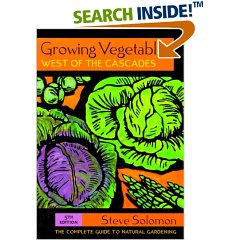
Growing Vegetables West Of The Cascades


The BEST gardening book I've found for the North Coast!
This is my all time favorite gardening book right now. If I lived south of here or east of here, it wouldn't be very useful, but in Humboldt Co., it's the only book that can explain how to grow vegetables out here. It's actually geared towards Washington and Oregon, but applies quite nicely to Humboldt, especially the northern end of the county. We're a bit warmer than some of the areas described in the book and our growing season is longer. Where this book is very helpful is when it comes to soil. Our soil here is acidic, just as it is north to us, and that plays a huge part in gardening here. We're also very wet here and not too warm, unless you live inland about 40 miles. This book addresses those issues. This book covers an incredible amount in only 340 pages. From soil to composting, to garden planning to water to starting plants from seeds (as well as collecting your own from your plants) to transplanting the seedlings. He even has a section on predators that are indigenous to our area, as well as how to build a cloche. This book is my gardening bible, and if you are a gardener on the north coast, I highly recommend it. Until Amy Stewart quits messing around with flowers and writing for the North Coast Journal and gets down to the business of writing a garden (especially vegies) book for Humboldt County, this will be the only truly useful gardening book for you coastal Humboldt vegie growers.

You can check it out at Humboldt Library and see if it works for you, or go buy it through Amazon.com or see if any of our fine local book stores carry it.


Digg!